
Applying for a corporate loan? Learn what documents and financial information businesses should prepare to improve approval chances and streamline the loan application process.
Continue reading
Applying for a corporate loan? Learn what documents and financial information businesses should prepare to improve approval chances and streamline the loan application process.
Continue reading
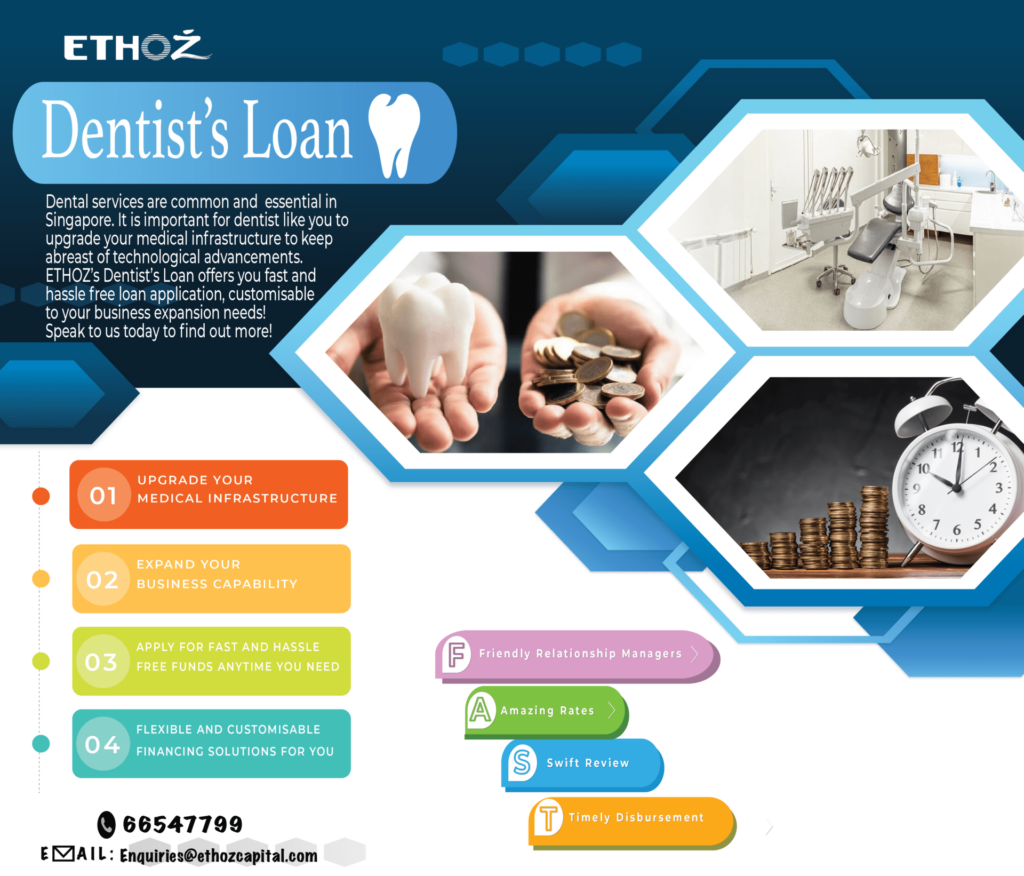
Dental services are common and essential in Singapore. It is important for dentist like you to upgrade your medical infrastructure to keep abreast of technological advancements. ETHOZ Dentist’s Loan offers you fast and hassle free loan application, customisable to your business expansion needs!
Speak to us today to find out more!

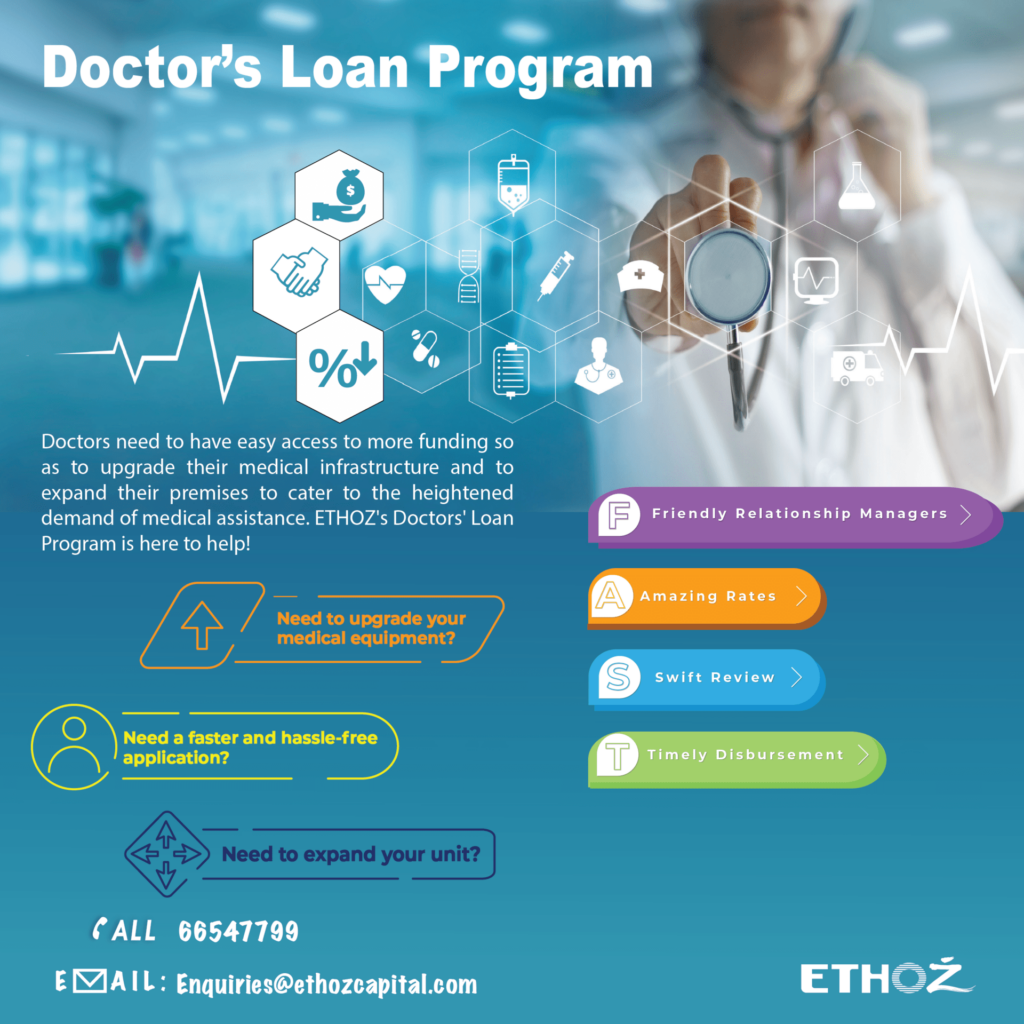
Need to upgrade your medical equipment and expand your premises? Doctor’s Loan Program is here to help!
We are dedicated to helping the growth of your business through providing you easy access to more funding for your daily operations, anytime you need.
Contact us to find out more!

Learn how effective working capital management helps businesses improve cash flow, support daily operations, and strengthen long-term profitability.
Continue reading
The four factors of production that drive an economy and keep businesses chugging along day after day, year after year are land, labour, entrepreneurship and capital. Of these, capital which comprises factory equipment, tools and other similar manufacturing agents is one of the easiest to obtain and scale according to output. It is the only factor that is man-made. It is the most conspicuous physical representation of any commercial venture. From a hand saw used to make bespoke furniture to computers or the large factory line machines churning out an endless stream of products, these are the long term physical assets that are the backbone of a company.
Acquiring the requisite business equipment is clearly essential if it intends to get off the ground and also as a going concern thereafter. These assets are also classified as Plant, Property & Equipment on a company’s balance sheet and make up a portion of a company’s net worth. It is vital to quickly and economically obtain, upgrade or replace the equipment needed to sustain business operations but purchasing equipment outright can substantially strain a company’s cash flow. Business equipment financing can be a good solution to keep a business functioning optimally or meet increasing customer demand.
Paying for equipment in full with cash has both advantages and disadvantages. Capital allowances are permitted in investments on fixed assets. It reduces the taxable income at the end of an assessment year, reducing the tax burden. This can be claimed over 2 – 3 years or over the useful life of the asset as prescribed by the authorities for a given asset class. As the owner of the asset, one can also exercise the decision to modify, sell or dispose of the asset. This is usually not possible in a leasing arrangement where terms of the contract have to be abided by. This can be beneficial as one can then service, improve or customise the equipment without seeking the approval of the lessor who is the legal owner of the property.
If the business owner has full ownership of the machinery, it can be seen as a more liquid asset where it can be sold or further rented out to generate cash flow to fund other more essential parts of the business.
However, this may be a prudent avenue if the return on investment exceeds the loan interest rates. In such a case, taking the loan generates more returns than it costs and can be considered a smart use of leverage.
Approaching a bank for a loan is taking a step towards maximising the benefits of leverage. In such a strategy, a business owner buys equipment on credit by obtaining a sum of money from a bank and repaying over the life of the loan with interest. Like making capital investments with one’s or a company’s funds, the advantages of full ownership, as mentioned above, can be enjoyed.
These loans, however, may come with conditions of their own, especially if the item itself forms the collateral. In this case, maintenance, sale or modifications may be restricted. The item could also be repossessed and sold off if the borrower falls behind on loan repayments.
Aiming to spur innovation, government grants or start-up schemes are also widely available to bring financial aid to the aspiring business owner. Several government agencies such as Enterprise Singapore, Ministry of Trade and Investment amongst others have made funding available to small and medium enterprises (SMEs) such as the often mentioned PSG (Productivity Solutions Grant) and EDG (Enterprise Development Grant). These defray the costs of capital investments but have to meet the requirements set forth, such as increasing employee headcount or achieving a certain level of revenue. The upside is that these are the “cheapest” form of financing but could be restricted by the need to meet predefined milestones or losing some autonomy in business decisions.
Both are similar in the sense that funds come from private sources. The difference is that venture capital pools money from multiple sources such as investment companies, a diverse set of individuals, pension funds or even other corporations while angel investors are described as investors using their own money.
These private investors are primarily concerned with a return on their investment and may set conditions and benchmarks to attain within a timeframe. Additionally, it is common for a percentage of equity in the company as part of the remuneration. This essentially gives away part ownership in one’s company.
Capitalising on the connectivity of the internet, crowdfunding brings together a disparate group of people to fund a project. This works best if the company is started to build a product that it can deliver to its backers. The upside is that there is no cost to the company, except in marketing the project to build interest and there is no obligation to release the product at all – the backers bear a large share of the risk. The transaction is facilitated by online platforms such as Kickstarter, GoFundme and Indigogo.
Returning to more conventional territory, capital leases are one of the most popular methods of funding capital purchases.
With the availability of customisation and choices to choose from with regard to repayment, front load deposit or open-end payments, those looking for a lease are spoilt for choice.
In addition to traditional financial institutions that most borrowers are used to, there are also alternative lenders that can provide the right leasing facility. These equipment leases can also be catered for a transfer in ownership at the end of the contract period or the items can be returned to the lessor. Those taking up such arrangements can find the benefit of enjoying the long term use of vital equipment while freeing up liquidity or providing better control of cash flow management.
Small businesses and start ups face many challenges in establishing themselves in the industry. Choosing the right method to finance that all important investment in crucial equipment like factory hardware or even commercial vehicles to bring the goods to market is a long-term commitment that would make an impact on every business owner.


Loans can sound like a taboo word and it can well be if taken hastily or for the wrong reasons – much like how self-medicating, even with the best of intentions, can be harmful. However, there are many prudent, intelligent reasons that justify borrowing.
The advantages of a loan secured by property or other collateral
Secured lending comes with lower interest rates or better terms compared to unsecured lending. The logic is simple, if the mechanics are anything but. Evaluating risk is at the heart of what a banker does, regardless of whether he is providing financing advice or extending facilities to customers. Accurately assessing the risk profile of its clients and astutely managing that risk is what the banking industry is built on.
An unsecured loan is riskier because a banker or financial institution can only depend on a borrower’s creditworthiness to evaluate whether a loan would be paid back on time, in accordance with the contracted terms. In case of a failure to satisfy one’s repayment obligations, the bank has fewer options available for recourse. The bank does not automatically have a right over any of the borrower’s property and instead has to first commence legal proceedings in order to obtain a writ of seizure, that would allow a bailiff to make lawful claims on personal property of any value. This would then be liquidated and go towards restitution of the defaulted loans. In the worst case scenario, non performing loans would be declared bad debts and written off, after the proper accounting rules have been followed. Although banks would prefer any and all loans to be guaranteed by an asset, the relatively smaller amounts usually do not warrant it or in the case of student loans, the lender might have few assets worth pledging.
In contrast, secured loans are much less risky because the lender has a lien on specific assets linked contractually to the loan. This gives the lender a legal right to seize the pledged property in lieu of payments. With this privilege, banks are able to extend better loan terms. Apart from lower interest rates, late penalties might also be more forgiving where there could be longer grace periods and smaller late fees. Typically, secured loans are also easier to obtain, and could be approved for larger principle sums.
Common Types of Secured Loans
Secured loans are commonplace, to the point that it is often unnoticed. Often, the most significant ones encountered by most of us are the auto loan and property mortgage. This means that the bank can repossess the vehicle or foreclose on the property when sufficient time has lapsed and a certain predetermined number of payments have been missed. For businesses, instruments such as letters of credit, standby letters of credit facilitate act as form of surety between merchants and suppliers, and thereby providing a form of short term loan. On a smaller scale individuals might be familiar with pawnshop loans and payday loans. With the former, personal property such as jewellery or other expensive effects are kept with the pawnbroker and returned only when the loan is repaid. Payday loans, as the name suggests, pledges an individual’s future income in return for a loan upfront. These are offered here by licensed money lenders and the process could be as simple as writing a post dated cheque. To investors, margin trading is yet another example of the many forms of secured lending in everyday life. In this case, an investor sets up a trading account with a brokerage firm and uses leverage to multiply an investment. However, if the markets turn on the investor, the brokerage can liquidate the account to recover the loan amount.
Quality of Collateral
Just as there seems to be a hierarchy in the type and assortment of loans, so too collateral varies in preference. When valuing an asset to be pledged, four factors are considered: condition, liquidation value, ease of liquidation, and nature of the asset. The first condition takes into account depreciation of physical assets and its remaining value. The next two consider its market value, cost of liquidation and efforts needed to dispose of the asset. The final point takes note of the type of asset and its scale.
With these guidelines, two methods for valuing collateral are employed. One of them is to compare it to similar assets with established monetary values as a proxy. The other is to consult with a qualified assessor with strong knowledge of the asset type.
Through these studies over time, a correlation between quality of collateral and quality of borrower had been determined. It was found that individuals and companies that could provide strong collateral were also more likely to honour repayment terms and had a lower probability of defaulting. Additionally, a link was also found between those with high quality assets to pledge and a higher degree of prudence in the use of loan funds. All these factors point toward a lower risk profile.
In short, high quality assets mitigate are of suitable value relative to the loan amount and are easily liquidated – all of which reduces the risk to the lender. Cash, as always, is king. Cash in bank accounts make the best collateral. Of equal quality are near-cash assets such as certificates of deposit, foreign currency, securities, bonds and other similar instruments. Next in line are high value tangible assets like property, vehicles, precious metals and jewels. At the other end of the spectrum, increasing willingness to expand the pool of clientele has prompted institutions to accept less conventional forms as collateral. These can range from expensive equipment like golf clubs and electronics to exotic items such as art and wine collections or medical instruments.
Just like the lenders that assess risk before extending a loan offer, the borrower also has to evaluate risks involved in accepting. However, if it is managed properly both parties can reach a win-win situation.

Discover alternative business financing options companies can use to manage cash flow, support growth and fund expansion.
Continue reading

If you have ever been in the market for big ticket items or planned for substantial capital investments, chances are that you would have considered hire-purchasing as a potential financing option. From as far back as nineteenth century England, which saw the emergence of these contracts and its rapid adoption through the crown colonies, until today’s car market, hire purchasing has been a popular option with customers considering an expensive purchase.
Considering just how commonplace these contracts have become, it can come in a number of guises (for example it is known as an installment plan in the USA or simply a car loan in Malaysia) and flavors but all adhere to the same basic principles. At the heart of it, hire purchase contracts involve an exchange of goods between buyer and seller after an initial payment or set-up fee, with the outstanding balance being paid with interest over a period of time. However, the defining aspect comes with ownership of the asset. Throughout the tenure of the contract, ownership of the goods remains with the seller or financial institution drafting the contract. It is only upon conclusion of the agreement, that the buyer has an option to go ahead with the purchase for a charge called an option-to-purchase fee. After which, ownership then transfers to the buyer. Such an arrangement presents several advantages and a few disadvantages to an individual or enterprise.
The most immediately apparent advantage of hire purchasing is that the asset or good can be immediately utilised and put into service with much less initial outlay than would otherwise be required. This typically ranges from a deposit or set-up fee of 10% for most assets, to 30% for new vehicles. A business that needs to make capital investments to kick-start its operations could find this the most expedient choice.
2. Easing the Financial Burden
Similarly, the financial burden is also reduced since payments are periodic and spread over a length of time. Start up costs can be significant but absolutely essential and so breaking up this commitment into smaller pieces can dramatically alleviate the financial strain.
3. Lower Interest with Secured Lending
Hire purchasing can also be a cheaper form of financing. The nature of these contracts makes it similar to collateralised loans, since the asset ownership only legally transfers to the buyer at the end of the agreement. As such, interest rates are generally lower than other forms of business financing like unsecured term loans. Assuming that the buyer does not terminate the agreement or repay early, the EIR (Effective Interest Rate) of hire purchase agreements can vary at about 5-6% as compared with unsecured loans that may be as high as 9%.
4. Flat Interest Rate
Another advantage is that hire purchase contracts have a flat interest rate. This means that the interest rate remains the same across the life of the contract without fluctuating. This may or may not be beneficial depending on the prevailing interest rates but it keeps payments predictable and thus makes budgeting, as well as cash flow management easier.
5. Accounting for Hire Purchase Contracts
For those keeping close tabs on their finances, there are also some tax and regulatory upsides to using hire purchase contracts to finance asset purchases. The first is that GST (Goods and Services Tax) is not charged on the interest portion of the contract so there are no additional financial obligations owed to the government in this area. Next, is that a tax relief can be claimed on qualifying fixed assets under the Hire Purchase Act in Singapore. Referred to an asset allowance, 100% of the price of goods can be written off over 1, 2 or 3 years, allowing the buyer to manage the amount of tax payable. Lastly, even the interest portion is listed as a qualifying allowable business expense which can be used to reduce the amount of tax payable.
With regard to accounting, the treatment of hire purchases on the books can have several benefits. This is because equipment obtained this way is not counted as part of the company’s assets, at least until ownership has been transferred through the exercise of the option to purchase at the end of the contract. One prime example is the analysis of metrics such as fixed assets turnover, that investors and other stakeholders might be interested in. Since the fixed assets turnover is expressed as a fraction of turnover against the value of fixed assets, a company could reap the benefits of larger turnover as generated by new equipment and machinery, without having the value of the same assets on the books. The same case can be made for other measures of operational efficiency like return on gross fixed assets or return on net assets.
*Note: The above information on Tax & Accounting treatment is strictly for reference only, business owners should seek professional advice from your own tax consultant or auditor.
Just as there are many good reasons to opt for this method of asset financing, there are several drawbacks too. The advantage of perceived affordability is a double-edged sword. With financing available, an entity may be proverbially biting off more than it can chew and proceed with a purchase under a hire purchase contract when it would be more prudent to put it off. There could also be the temptation to choose more expensive or technologically advanced options that now become within reach. As a contract between buyer and seller, terms can be priced, negotiated and included or omitted while it is being drawn up. Zero downpayment, for instance, allows the buyer to take home the goods with nothing out of pocket. However, this would surely increase all or any of the other terms like duration and interest.
2. Inflexible Contracts
In the event that a company over extends itself and defaults on payments, the item can legally be repossessed. On the other hand, if a company subsequently finds itself in a position to make full payment, it may not always be possible to repay early or there could be additional fees involved to do so. With a payment default, it doesn’t just end in the seller regaining possession of the asset either. It will go on record and have a negative impact on the buyer’s credit profile, affecting the ability to apply for financing in the future. This also includes any future decisions to enter other hire purchase contracts, as the terms are dependent on the applicant’s credit history, and a better credit score usually results in better terms.
With the introduction of Total Debt Servicing Ratio (TDSR) in Singapore to calculate an individual’s capacity to obtain financing, especially for home ownership, the number and value of hire purchase contracts one holds comes into consideration. The contract to take home the latest electronics or speed home in a sports car will have an impact on getting a home loan.
3. Asset Obsolescence
Finally, the length of the contract might be a substantial amount of time, stretching into years. By that time, the asset could have depreciated so much that it has no value at the end of the contract. In such a scenario, it might be better to take on a finance lease which could potentially be more cost effective.
As we have seen, with its unique set of pros and cons, hire purchasing may not be the most suitable alternative for every individual or business but it still plays a vital role in the litany of financing options available. Small scale businesses and entrepreneurs can benefit most from hire purchase. High value, crucial and strategic assets can be hired and later owned. This ensures that they can start using the asset right away from the very first day and use the money generated to acquire the very same assets later.

Learn how businesses in Singapore can choose the right financing solution by understanding different business loan options and key decision factors.
Continue reading

Businesses need financial funding to be able to progress successfully in the marketplace. However, loans will add up and too much borrowing can lead to more liabilities for the business. Business loans are a popular or famous choice for new startup businesses besides opening a line of credit or corporate credit cards. The amount of loans borrowed differ in loan companies, with different interest rates. Thus, some rare cases involve businesses keeping themselves out of financial risk by getting investment from family and friends. That being said, we will understand in this comprehensive article about how borrowing business loans with high interest rates will slowly kill businesses.
Why Do Businesses Take Loans? Cash Flow
The first reason for borrowing is the cash flow that a business needs. When a business starts to operate, the profit, capital and revenue are generally low and cannot cover much of the normal expenses. Moreover, the business needs to offer salary for employee and personal expenditures – especially if the wages or salaries need to be paid punctually. Apart from its personal expenditures on labour, the business would need to pay for its rent, utilities, insurance and other significant regular expenses that are norms of a business operations. These can be covered by a business loan such as a working capital loan.
Potential Expansion
Your business is already doing well, and it has garnered much attention and awareness in the market. Thus, the demand for your products or services have significantly increased. What happens next is the potential business expansion that you need and this comes with new additional expenses. If your company has outgrown its current potential capacity and it requires a bigger space, that means more rental, maintenance and operational fees. This would mean that you need to receive more funds to meet the increased demand for your product or services, through a business loan like a term loan. Moreover, you have to obtain the funds to pay for manufacturing costs, hire new employees – causing an increase in funding. Thus, the amount of funds you have borrowed would also differ and depends on the extent and type of interest rates inputted.
Disadvantages of High Interest Loans from Borrowing
Once the business has started on its borrowing and once it starts to accumulate, the loans become extremely large till the business owner finally notices how bad the situations are. It is then difficult to recover and pay from a large amount of debt. The recovery process would take some time for the business due to its incredible large amount accumulated from high interest rates.
Firstly, the business is legally and ethically obligated to pay back the principal borrowed from the loan company along with its interest amount. Businesses that are already suffering from cash flow problems may then face a difficult time of repaying the money with its incremental and additional cost of high interests. If the principal cannot be paid on time, there will be punishment or penalties that are given to these companies.
Moreover, the previous point will lead to how debt or loan financing will affect the credit rating of a business. If the company or business is known to have a significantly greater amount of debt than equity or capital financing, it is then considered risky. What happens next is that a company with a lower credit rating generally will have to pay a higher interest rate to attract investors to invest in their business. And this means that the company or business who have to pay more interest may even experience a potential cash flow problem in the near future.
Thus, the business or company that seeks to obtain debt financing must meet the lender’s cash requirement, which means that they need to have sufficient cash on hand. And if they require even more funding in future, but still have outstanding debts, the business might potentially shut down and still have debts owing on hand. This is not an ideal situation, especially if the interest rate is extremely high. Thus, it is difficult for businesses depending on debt financing for further cash support. Some companies or businesses may even have to put up collateral to qualify for financing. And it is quite embarrassing to be owing a huge amount of debt, in an industry full of successful businesses.
How to Move Forward
At this point, we believe that you have understood the impact of having high interest rate borrowing from loan companies. What’s important for you then is to find a professional, reliable and affordable financing provider for your business.
As one of the top professional providers of affordable capital and financing solutions in Singapore, ETHOZ offers capital financing, SME micro loans, term loans, equipment leasing solutions, commercial vehicle financing, auto leasing, and other financial and automotive services to businesses in Singapore seeking to optimise their operations, where zero downtime, predictable operating costs and controlled cash flow outlay are paramount. For companies looking to save costs and support their cash flow, ETHOZ has a solution for you.
Evolving from its humble roots in car leasing to become a full-fledged financial solution and automotive provider, we pride ourselves in helping businesses to save costs and obtain the financing they need to grow and thrive.
If you ever need any help to support the financial aspirations of your business, you can simply reach out to a member of our team at contactus@ethozgroup.com to explore the options available to you.